Backing Welsh Farmers: The People Who Feed Wales

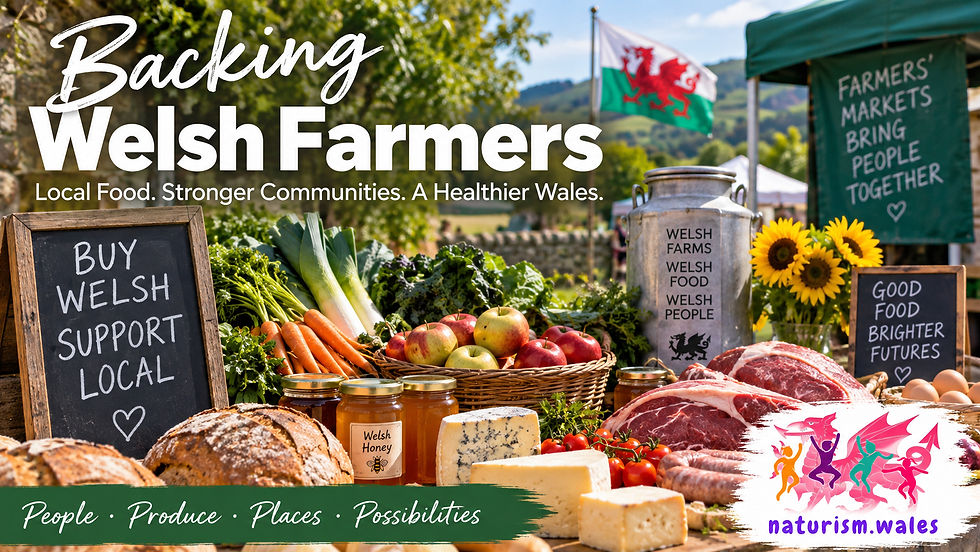
There are few industries more deeply woven into the story of Wales than farming.
Our landscape has been shaped by generations of farmers. Our food traditions grew from it.
Much of our countryside is still actively managed through it. The patchwork of fields, hedgerows, stone walls and grazing land that we sometimes take for granted is not simply scenery. It is, in large part, a working landscape.
And behind that landscape are people.
Families getting up before most of us are awake. Businesses dealing with weather they cannot control, costs they cannot always pass on and markets whose prices can change dramatically. People producing the milk, meat, eggs, vegetables, potatoes, fruit, honey and countless other products that eventually appear on our tables.
Perhaps we should think about them a little more often.
Farming is part of Wales
More than 90% of the land area of Wales is given over to farming, according to the Welsh Government’s latest agricultural survey.
In 2025, Welsh farms were home to around 8.8 million sheep and lambs and approximately 1.08 million cattle and calves. There were around 38,700 principal farmers, directors, business partners and spouses involved in agricultural holdings, alongside thousands of people employed on farms.
Agriculture is therefore considerably more than an industry tucked away somewhere beyond our towns and cities.
It is part of the physical and cultural infrastructure of Wales.
The economic contribution is substantial too. Provisional Welsh Government figures put the value of Welsh agricultural output in 2025 at around £2.4 billion. Cattle and sheep alone represented around 36% of the value of agricultural output, while milk and milk products were worth approximately £929 million.
Those are impressive numbers, but statistics can disguise something important.
A £2.4 billion industry is ultimately made up of individual farms, families and rural businesses trying to make a living.
Buying Welsh is a small decision with a much bigger story
Most of us cannot determine agricultural policy. We cannot control international commodity markets, energy prices, feed costs or the weather.
But we do make decisions every time we shop.
Choosing Welsh produce where it is available connects our household spending with the communities producing our food.
It might mean buying Welsh lamb or beef from a local butcher. It could be eggs from a nearby farm, Welsh cheese, locally grown vegetables, honey produced a few miles away or potatoes with an identifiable Welsh producer behind them.
It does not require perfection and it certainly does not require turning the weekly food shop into an exercise in guilt.
It simply requires occasionally asking a different question:
Where did this come from?
There is also something rather satisfying about buying food from somebody who can actually tell you where it came from.
At a farmers’ market, farm shop or independent producer, the distance between producer and customer becomes remarkably short.
Sometimes the person handing you the food is the person who grew it, raised it, baked it or made it.
That relationship has value.
The Welsh Government’s current Rooted in Wales campaign makes a similar argument: farmers, growers, manufacturers, retailers and consumers are interconnected parts of the same Welsh food system.
If we want thriving rural communities and high-quality Welsh food tomorrow, there has to be a viable market for that food today.
Rediscover the farmers’ market
One of the easiest — and considerably more enjoyable — ways of doing this is to visit one of Wales’s regular farmers’ and produce markets.
There are some excellent examples around the country.
Aberystwyth Farmers’ Market operates at the top of town by the Market Hall, normally on the first and third Saturday of each month.
Established in 2000, it can host around 30 stalls offering seasonal vegetables, Welsh cheeses, eggs, locally raised meat and poultry, honey, bread and other produce.
In Cardiff, local food markets are remarkably accessible. Riverside Farmers’ Market operates every Sunday, while Roath runs on Saturdays and Rhiwbina on Fridays. Together the Cardiff Farmers Markets network represents more than 100 farmers and small producers.
Brecon Farmers & Makers Market is held at Brecon Market Hall on the second Saturday of the month, bringing together local food, drink and artisan producers.
Elsewhere across Bannau Brycheiniog and the surrounding communities there are regular markets at places including Abergavenny, Hay-on-Wye, Llandovery and Myddfai.
In west Wales, Haverfordwest Farmers’ Market has traditionally operated weekly on Fridays, while towns throughout Wales have their own farm shops, produce markets, independent butchers, dairies, growers and food businesses worth discovering.
And here in Flintshire, we should not overlook the independent shops and market traders selling Welsh produce on our own doorstep.
Before travelling specifically for any market, check its current organiser’s information because dates, locations and trading arrangements can change.
But perhaps make a point this autumn of visiting one.
Take a bag. Talk to the traders. Ask where something came from. Try something you would not normally put in the supermarket trolley.
You may discover that supporting Welsh farming tastes rather good.
Could naturism support Welsh farms too?
There is another reason I wanted to write this.
Naturism Wales is a Welsh community organisation, and I believe community should extend beyond the people already inside our own circle.
So I would like to make an invitation.
If you are a farmer or landowner in Wales and think there might be an interesting way for Naturism Wales to work with you, we would genuinely like to hear from you.
That does not necessarily mean establishing a permanent naturist venue.
Think smaller. Think creatively.
Perhaps a field could accommodate a temporary camping weekend at the right time of year.
Perhaps a farm has an interesting activity, experience or facility that could form part of an organised event.
Perhaps there is an opportunity for our members to visit, learn about farming, buy produce directly or support diversification on a Welsh farm.
There may be farms with woodland, secluded fields, walking routes, workshops, farm shops or other spaces where something unusual and mutually beneficial could happen.
And there may be possibilities we simply haven’t thought of yet.
Naturism Wales would, of course, approach any proposal responsibly, with appropriate safeguarding, privacy, insurance, permissions, risk assessment and respect for the normal operation of the farm.
We are not looking for somebody to hand over their farm to a collection of naked people for the weekend and hope for the best.
We are interested in sensible partnerships.
Farming and naturism have something in common
Perhaps there is a deeper connection here too.
Naturism encourages us to reconnect with things modern life can make strangely distant: our bodies, nature, seasons, weather and one another.
Farming lives according to many of those same realities.
You cannot negotiate with December and persuade it to become June. Grass grows when conditions allow it. Animals need caring for regardless of whether it is Sunday morning. Seasons still matter.
There is something wonderfully grounding about that.
Welsh farmers are custodians of much of the countryside we love. They produce extraordinary food, maintain rural businesses and communities, and continue traditions that stretch back through generations.
Supporting them does not require a grand gesture.
Sometimes it is simply choosing the Welsh option.
Sometimes it is visiting the farmers’ market instead of automatically reaching for something that has travelled hundreds or thousands of miles.
Sometimes it is stopping at the farm shop we have driven past fifty times and finally going inside.
And perhaps, occasionally, it could mean Welsh farmers and the Naturism Wales community finding new ways of supporting one another.
Because if community means anything, surely it means recognising that the choices we make can help the people around us thrive.
So this week, I have two questions.
What Welsh-produced food do you deliberately buy — and if you’re a Welsh farmer, what could a community like ours do that would genuinely help you?