

“Don’t Pull the Dog’s Tail: How Entitlement Bites Back (and Why Kindness Still Wins)”

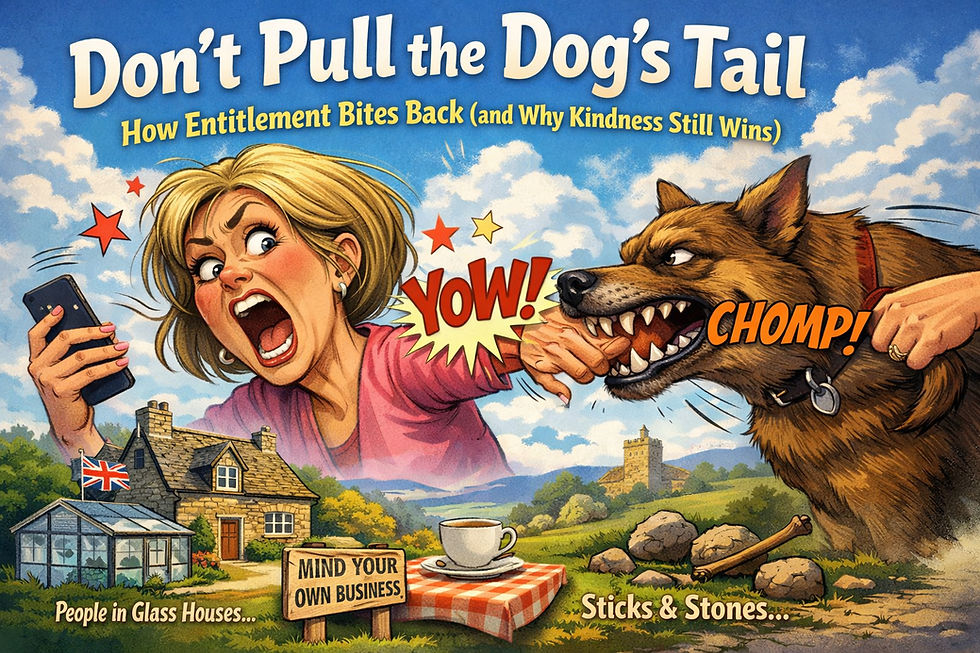
There was a time—not so long ago, though it now feels faintly sepia-toned—when the unspoken social contract was simple: mind your own business, be decent to others, and don’t go poking things that might bite back. It wasn’t perfect (nothing human ever is), but it carried a quiet wisdom that smoothed the edges of everyday life. Fast forward to today, and we seem to be navigating an age increasingly characterised by something far louder, shinier, and—let’s be honest—a touch more exhausting: entitlement.
This modern phenomenon, often playfully (and sometimes unfairly) caricatured as the “Karen” mentality, has become a cultural shorthand for a particular kind of behaviour—demanding, self-centred, and often blissfully unaware of its own absurdity. While the label itself is a meme, the underlying psychology is worth examining with a more serious lens. Because beneath the viral videos and eye-rolling anecdotes lies a deeper shift in how individuals relate to society, authority, and each other.
The Rise of Entitlement: A Cultural Evolution
From an academic perspective, entitlement is often linked to shifts in individualism. Sociologists like Jean Twenge and Keith Campbell (noted for their work on narcissism and generational change) have argued that Western societies—particularly since the late 20th century—have increasingly prioritised self-expression, personal rights, and individual validation. These are not inherently bad things; in fact, they’ve driven progress in equality and personal freedom. But, like overwatering a plant, too much of a good thing can lead to… well, rot.
Psychologists define entitlement as a stable and pervasive sense that one deserves more than others, regardless of effort or merit. Research published in journals such as Personality and Social Psychology Review links high entitlement to lower empathy, increased aggression in response to criticism, and a tendency to externalise blame. In simple terms: “It’s not me, it’s definitely you—and I’d like to speak to your manager about it.”
Add social media to the mix—a digital stage where outrage is rewarded with attention—and entitlement becomes performative. A minor inconvenience isn’t just frustrating; it’s content. The everyday becomes a battleground of perceived injustices, each one deserving of a dramatic monologue and, ideally, a viral audience.
The “Karen” as a Cultural Symbol
Let’s be clear: the “Karen” isn’t a person—it’s a pattern. It’s the exaggerated expression of entitlement, where minor grievances escalate into theatrical crusades. It’s the belief that the world should bend, immediately and without question, to one’s personal expectations.
And here’s where it becomes detrimental—not just annoying, but socially corrosive. Entitlement erodes empathy. It replaces curiosity with accusation, patience with demand, and mutual respect with hierarchy (“I am the customer, therefore I am supreme”). It creates unnecessary conflict in spaces that would otherwise function perfectly well with a bit of understanding and, dare we say it, a sense of humour.
Because let’s face it—many of these situations are, objectively, quite funny. The person shouting at a self-checkout machine as if it’s personally offended them. The dramatic sighs over a slightly over-toasted slice of sourdough. The righteous indignation of someone who has, quite literally, brought a problem upon themselves.
Which brings us neatly to one of life’s oldest and wisest lessons: don’t pull the dog’s tail.
Actions, Consequences, and the Bite of Reality
There is something almost poetic—if slightly slapstick—about watching entitlement meet consequence. Not in a cruel way, but in the same spirit as a cartoon character slipping on a banana peel they themselves discarded.
When someone provokes, prods, or persistently ignores boundaries—whether social, emotional, or indeed canine—there’s often an inevitable moment of reckoning. The shock that follows is fascinating. Eyes widen. Voices rise. “How dare this happen to me?” comes the unspoken cry, as though reality itself has breached contract.
But reality, inconveniently, doesn’t operate on personal entitlement. It operates on cause and effect. You tug the tail, the dog objects. You shout at the world, the world occasionally shouts back. It’s less a punishment and more a reminder: you are not exempt from the rules of shared existence.
The Wisdom of Old Sayings (They Were Onto Something)
This is where those wonderfully blunt traditional sayings come back into play. They may sound quaint, but they carry a depth of social intelligence that modern discourse sometimes lacks:
Mind your own business – A radical concept in the age of unsolicited opinions.
People who live in glass houses shouldn’t throw stones – Or, in modern terms, maybe don’t criticise others while livestreaming your own chaos.
Sticks and stones may break my bones, but names will never hurt me – Perhaps a slightly optimistic take, but it does encourage resilience over outrage.
These weren’t just phrases—they were behavioural guidelines. They promoted restraint, humility, and a quiet respect for others’ space and autonomy. Not repression, but balance.
A Gentle (and Slightly Cheeky) Call to Kindness
The truth is, the world owes us nothing—and oddly, that’s quite freeing. It means we’re not in constant negotiation with reality. It means we can meet life as it is, rather than how we think it should be.
Kindness, acceptance, and respect aren’t outdated ideals; they’re social glue. They make interactions smoother, communities stronger, and life generally more pleasant. And they cost absolutely nothing—no subscription required, no app download necessary.
Imagine a world where, instead of escalating every inconvenience, we paused and thought: Is this worth the energy? Where a smile replaced a complaint, and curiosity replaced confrontation. Where we laughed at the absurdities of life—including our own.
Because we all have our moments. Everyone has, at some point, muttered dramatically at an inanimate object or felt personally victimised by a slow Wi-Fi connection. The difference is whether we lean into that moment—or laugh at it.
Final Thought: Choose Wisdom (and Maybe Don’t Poke the Dog)
Entitlement may be loud, but wisdom is quietly enduring. The choice isn’t between having standards and “putting up with things”—it’s between reacting and responding, between demanding and understanding.
So, by all means, stand up for what matters. But perhaps leave the theatrical outrage at the door, along with the imaginary crown of universal importance.
Be kind. Be curious. Be the person who makes a situation lighter, not heavier.
And if you ever find yourself tempted to pull a metaphorical dog’s tail—pause, smile, and remember: some lessons come with teeth.


