Why Are British People Afraid of Public Nudity?


Understanding the Cultural Contradictions Around the Naked Body
Walk into a British leisure centre changing room and you will see naked bodies everywhere. Visit an art gallery and people admire marble sculptures of perfect human forms. Yet if someone quietly walks naked on a beach or along a rural path, it can trigger outrage or alarm.
This contradiction reveals something interesting about British culture: the body itself is not the real problem. The discomfort lies in where and why nudity appears.
Exploring these attitudes helps explain why public nudity often feels controversial in Britain—even though non-sexual naturism is largely legal and protected as a form of expression.
A Culture Shaped by History and Modesty
British discomfort with nudity has deep historical roots. During the Victorian era in the 19th century, ideas about modesty and morality became extremely strict. The body became something to hide, regulate, and associate with sexuality or shame. Yet historically this was not always the case. Earlier periods of British life included:
• communal bathing
• nude swimming in rivers and the sea
• less rigid clothing standards
Over time Victorian moral codes reshaped attitudes, linking nudity strongly with sexuality and indecency. Many of these assumptions survived into modern society, even though the law itself evolved.
Today the law in the UK does not generally prohibit simple nudity. Authorities focus instead on behaviour and intent. If someone is naked without a sexual motive and without intending to cause alarm or distress, prosecution is usually considered inappropriate. In other words, being naked is not automatically illegal.
The Changing Room Paradox
One of the clearest contradictions is the British changing room. In swimming pools, gyms, or spas, people routinely undress in front of strangers. This is socially accepted because the context provides a clear explanation: people are changing clothes or showering. The same body in a different context, however, can suddenly feel uncomfortable to observers. This reveals something important:
The British public does not fear the naked body itself — it fears the breaking of social expectations. If nudity appears outside familiar situations, people often assume there must be something sexual or inappropriate happening.
Naturism challenges that assumption.
⸻
Why a Topless Man Is Acceptable but a Topless Woman Isn’t?
Another cultural contradiction is the difference between male and female toplessness.
On a hot summer day in Britain:
• a man walking shirtless may be seen as normal
• a topless woman may cause complaints or headlines
This difference largely comes from sexualisation of the female body, particularly breasts. In many societies female bodies are framed as inherently sexual, while male bodies are treated as neutral. Yet biologically and socially this distinction is largely cultural rather than rational.
Across much of Europe, topless sunbathing is common and unremarkable. In Britain, however, social norms still lag behind. Naturism communities often challenge this double standard by encouraging body equality, where all bodies are simply human bodies.
⸻
Why Nudity Is Acceptable in Art?
Curiously, Britain has no issue celebrating nudity in art. For example, visitors admire the famous Renaissance sculpture David by Michelangelo, a fully nude male figure representing idealised human beauty.
Similarly:
• classical paintings depict nude figures
• gardens display naked cherubs
• museums celebrate ancient sculptures
Why is this acceptable?
Because art creates psychological distance. The nude figure becomes symbolic rather than personal. It represents beauty, mythology, or history rather than a real person standing nearby.
Naturism, however, removes that distance. It reminds us that real bodies exist outside idealised art—in all shapes, ages, and forms.
For some people, that reality can feel confronting.
⸻
What the Law Actually Says.
A common myth in Britain is that public nudity is illegal. In reality, the law focuses on intent and behaviour, not simply being unclothed.
Under UK law:
• Nudity itself is not a crime.
• It becomes an offence only if someone exposes themselves with the intention of causing alarm or distress or behaves in a sexual or threatening way. 
Guidance from prosecutors also emphasises the need to balance:
• the right to freedom of expression, and
• the public’s right not to experience harassment. 
This means peaceful naturism—walking, sunbathing, swimming—often falls within lawful behaviour.
⸻
Naturism Is a Recognised Lifestyle
In the UK, naturism is widely understood as a philosophical lifestyle belief rather than a sexual activity. Organisations advocating for naturists have even argued that people practising naturism deserve protection from discrimination similar to other belief systems. 
For many participants, naturism is about:
• body acceptance
• equality
• connection with nature
• mental wellbeing
⸻
The Science: Why Naturism Is Actually Good for Us!
Research led by Keon West at Goldsmiths, University of London explored the psychological effects of naturist activity.
The findings were striking. People who spent time naked with others reported:
• higher body confidence
• improved self-esteem
• greater life satisfaction
The studies also showed that the more frequently people engaged in naturist activities, the happier they tended to feel about their bodies and their lives overall. 
Seeing ordinary, non-idealised bodies helps people develop healthier expectations of what real bodies look like. In a society where body image anxiety is common, this research suggests naturism may be part of the solution.
⸻
Promoting a Healthier Relationship With the Human Body
Fear of nudity often comes from unfamiliarity. When something is rarely seen, it becomes easy to assume it must be wrong or dangerous.
But history, law, and science all tell a different story.
The human body is not inherently offensive. It is simply human.
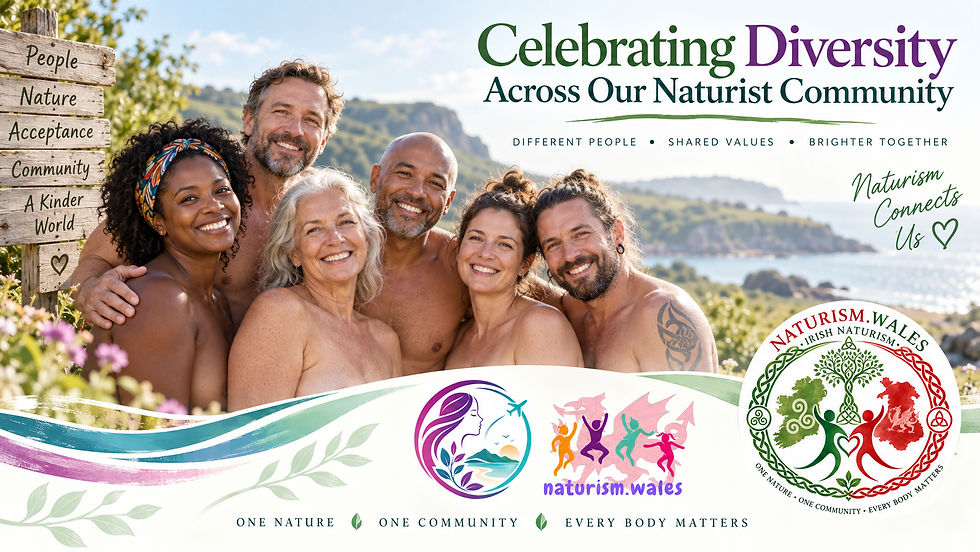
Communities like Naturism Wales aim to promote a respectful and welcoming environment where people can reconnect with that simple truth. Our message is simple:
Naturism is a legal and positive lifestyle philosophy that promotes body acceptance, equality, and wellbeing.
By encouraging understanding and openness, we can help Britain rediscover a healthier and more relaxed relationship with the human body.