A Pot Full of Wales: Eating Well Without Spending a Fortune

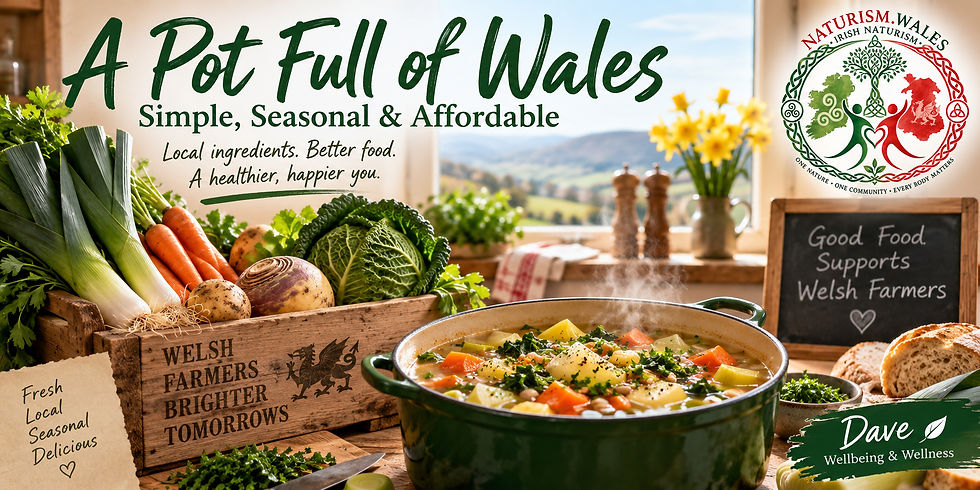
Supporting Welsh farmers sounds like a grand idea until somebody assumes it means filling the kitchen with expensive artisan produce.
It doesn’t have to.
Sometimes supporting local food begins with something considerably less glamorous: a leek, a couple of carrots, some potatoes and a big saucepan.
That feels rather appropriate for Wales.
This week Naturism Wales has been talking about buying local and supporting the farmers and growers who produce our food. There’s a wellbeing connection here too, because looking after ourselves and looking after the community around us don’t have to be separate things.
The Welsh Government’s current Rooted in Wales campaign encourages exactly that connection between farmers, growers, local businesses and the people who ultimately cook and eat the food.
So today I’m taking it into the kitchen.
Start With the Vegetables, Not the Recipe
One of the easiest ways to make fresh food affordable is to stop deciding exactly what you’re cooking before seeing what’s available.
Go to the greengrocer, market, farm shop or local producer and look first.
What’s plentiful?
What looks good?
What’s reasonably priced?
Then build dinner around it.
Carrots, potatoes, leeks, onions, cabbage, swede and other straightforward vegetables don’t need much interference from us. A pot, some stock and a little time can do most of the work.
Vegetables also provide fibre, vitamins and minerals, and NHS guidance recommends eating at least five portions of varied fruit and vegetables each day.
No powders. No fashionable “superfood”. Just food.
Dave’s Budget Welsh Vegetable Cawl
Traditional cawl varies considerably from one Welsh kitchen to another and commonly combines meat with potatoes, leeks and whatever seasonal vegetables are available. In North Wales, many of us will also recognise its close relative in the name lobsgows.
Mine is a cheaper vegetable-led version rather than a claim to be the traditional recipe.
Serves 4 generously
You’ll need:
4 medium potatoes
2 carrots
1 large leek
1 onion
About half a small swede
A handful of cabbage or other greens
1 tin of butter beans, cannellini beans or whatever beans you already have
1 vegetable stock cube
About 1 litre of water
Black pepper
A little thyme or parsley if available
Wash and roughly chop the vegetables. There’s no need for restaurant-perfect cubes.
Put the onion, carrots, swede and potatoes into a large saucepan with the stock and water. Bring it to the boil, turn the heat down and simmer gently until the vegetables are becoming tender.
Add the leek, cabbage and drained beans and cook for another 10–15 minutes.
Taste before adding any additional salt because stock cubes can already contain plenty. Add pepper and herbs if you have them.
That’s it.
A warm Welsh-style supper from one pot.
The beans are my little budget trick. Pulses provide protein and fibre, cost considerably less than many meats and make a vegetable broth much more substantial.
If you have leftover Welsh lamb, beef or ham, by all means add some. Traditional cawl often uses cheaper cuts of meat on the bone precisely because slow cooking extracts plenty of flavour.
But you don’t need meat to make tonight’s pot worthwhile.
Cook Once, Eat Twice
And here’s the bit that matters when money is tight.
Don’t cook four separate portions. Cook one pot.
Have it for dinner. Put the rest in the fridge promptly and reheat it thoroughly tomorrow, or freeze suitable portions for another day.
Welsh cawl has long had a reputation for tasting even better the following day as the flavours develop.
That’s the sort of wellbeing I like.
Good ingredients. Very little waste. Something warming waiting for tomorrow.
Supporting Welsh farming doesn’t require us to spend money we haven’t got. When the budget allows, buying even some of our vegetables, meat, dairy or other ingredients directly from Welsh producers keeps our relationship with food a little closer to home.
And perhaps that belongs in our understanding of naturism too.
Living closer to nature isn’t only about taking our clothes off.
It’s also about remembering that somebody grew the carrot. Somebody lifted the potato. Somebody tended the field.
Food doesn’t begin in a supermarket.
It begins with land and people.
What inexpensive Welsh ingredient could you build tomorrow’s dinner around?