The Woman Who Walked Out of a Welsh Lake

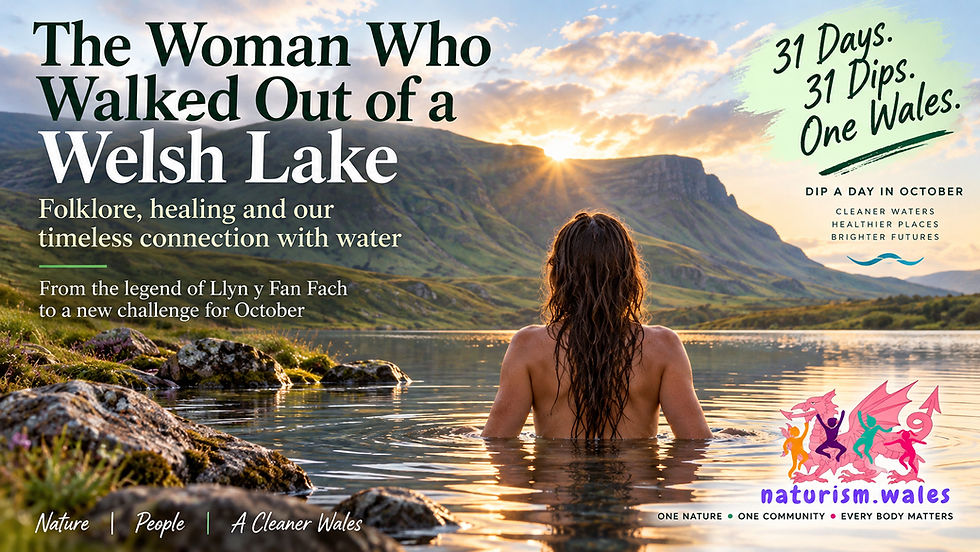
High in the Carmarthenshire mountains, beneath the great sweep of Bannau Brycheiniog, there is a lake with a story.
Llyn y Fan Fach is beautiful enough without embellishment. Dark water sits beneath the mountain escarpment, exposed to the changing Welsh weather and surrounded by a landscape that can feel remarkably remote.
But according to one of Wales’s great folk traditions, somebody once came out of that water.
Not a monster.
Not a ghost.
A woman.
And the story she left behind connects water, nature, healing and the Welsh landscape in a way that feels remarkably relevant hundreds of years later.
The Lady of Llyn y Fan Fach
There are different versions of the story, as you would expect from folklore passed between generations.
At its heart is a young man tending cattle near Llyn y Fan Fach who encounters a beautiful mysterious woman associated with the lake.
He falls in love with her.
Bread plays an unexpectedly important part in his courtship — which may be one of the most wonderfully Welsh elements of the entire affair — and eventually she agrees to become his wife.
But there is a condition.
Their marriage can continue only provided that he does not strike her three times without cause.
They marry, build a life together and have sons.
Eventually, however, the condition is broken.
After the third blow, the Lady leaves the human world and returns to the lake, taking her cattle with her.
That might have been the end of the story.
Instead, it becomes the beginning of another.
The Physicians of Myddfai
The sons of the Lady became associated in Welsh tradition with the legendary Physicians of Myddfai — Meddygon Myddfai.
Myddfai developed a remarkable reputation for physicians and herbal remedies, with medieval Welsh medical knowledge recorded in manuscripts and later published in the nineteenth century.
So folklore and history begin to intertwine.
A mysterious woman emerges from the natural world. Her descendants become healers.
Knowledge of plants, bodies and remedies passes between generations.
We don’t need to believe that a supernatural woman literally stepped from the lake to appreciate what the story tells us about the people who preserved it.
Nature mattered.
Water mattered.
Plants mattered.
The human body mattered.
And knowledge of the landscape could be knowledge of how to care for ourselves.
What does any of this have to do with naturism?
Quite a lot, actually — although not because we’re going to rewrite Welsh folklore and pretend the Lady of the Lake was a naturist.
She wasn’t.
What interests me is the relationship underneath the story.
Modern life has become extraordinarily good at putting barriers between ourselves and the natural world.
Walls. Cars. Screens. Central heating. Artificial light. Shoes. Layers of clothing. Schedules.
None of those things is inherently bad. I’m rather fond of central heating myself.
But occasionally we remove some of those barriers.
For naturists, removing clothing can be part of that. We feel wind properly against our skin. Sunshine feels different. Water certainly feels different.
Anyone who has swum without a costume will understand that last one immediately.
There is something wonderfully uncomplicated about the meeting point between skin and water.
Perhaps that is why swimming and naturism have been such natural companions for generations.
And that brings us to October
There is another reason I’ve chosen to tell you the story of Llyn y Fan Fach now.
Surfers Against Sewage are bringing back their Dip a Day in October challenge this autumn.
The idea is beautifully simple.
Dip in cold water every day throughout October and raise money to help protect our rivers and seas from sewage pollution.
Thirty-one days.
Thirty-one encounters with cold water.
And I think Naturism Wales should get involved.
Not by turning Llyn y Fan Fach into a naturist swimming destination. It isn’t, and this article should absolutely not be interpreted as encouraging anyone to strip off or enter the water there.
Instead, I’d like the Lady of the Lake to become our inspiration.
31 Days. 31 Dips. One Wales.
Throughout October, I’d love to see Naturism Wales members and readers joining the official Dip a Day challenge in whatever safe and appropriate way works for them.
Some might use the sea.
Others might have access to safe outdoor swimming.
Some may use a lido.
And if circumstances, accessibility or confidence make outdoor dipping unsuitable, the official challenge even allows something as simple as a cold shower or paddling pool.
Naturism can be part of your challenge where it is lawful, safe, appropriate and respectful of everybody else using the space.
But nudity isn’t the challenge.
Connection is.
For 31 days, deliberately experiencing something elemental that most of us spend much of our lives avoiding.
Cold water.
Skin.
Weather.
Nature.
And perhaps a slightly questionable decision at 7am on a wet October Tuesday in Wales.
That one may require considerably more enthusiasm.
There’s another reason this matters
The waters we romanticise in stories aren’t simply scenery.
They are ecosystems.
They are places where people swim, paddle, surf, walk, play and find peace.
They need protecting.
Surfers Against Sewage describes Dip a Day as one of its community fundraising challenges, bringing people across the UK together while raising money for work tackling sewage pollution in rivers and seas.
That makes this more than a cold-water stunt.
It gives the discomfort a purpose.
And there’s something rather appealing about a naturist community supporting the protection of the natural places from which our philosophy takes so much inspiration.
From an old Welsh story to a new Welsh challenge
I love folklore because underneath the fairies, supernatural cattle and impossible events there is often something very human.
People were trying to explain their relationship with the world around them.
Why does this place matter?
Why does water feel powerful?
Where does healing come from?
What knowledge does nature hold?
Centuries later, we’re asking some surprisingly similar questions.
We simply have different language for them.
So tomorrow morning, Llyn y Fan Fach will still be sitting beneath the mountains.
Whether a mysterious woman ever really walked out of its waters isn’t something any of us can prove.
But the story survived.
And perhaps this October we can give that old relationship between Wales, water and the human body a thoroughly modern chapter of our own.
Would you join Naturism Wales in taking on 31 dips in 31 days this October?