The Space Belongs to All of Us

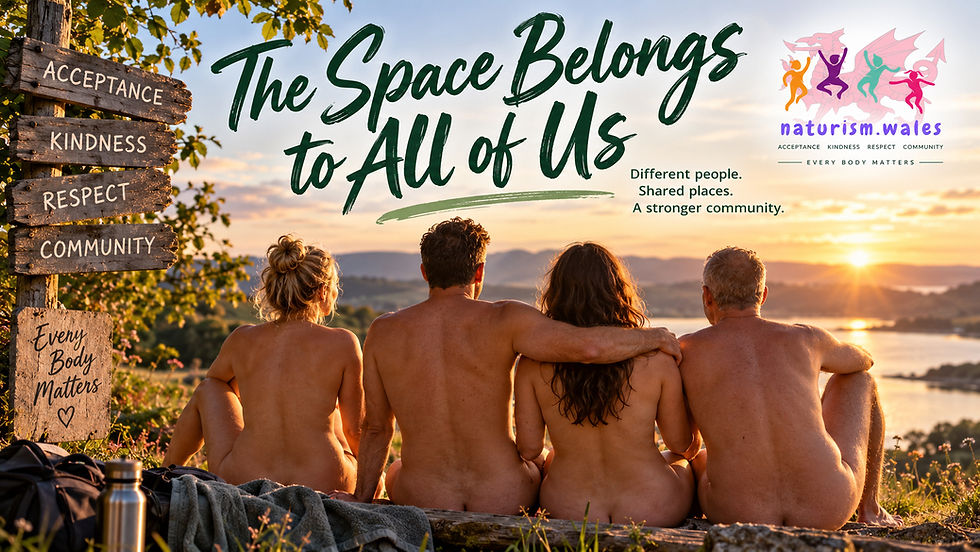
One of the great pleasures of naturism is the feeling that, for a little while, we can stop performing.
Nobody needs the right clothes. Nobody needs the right body. Nobody needs to look fashionable, impressive or particularly interesting. We simply get to be people.
But there is an important bargain hidden inside that freedom: the space belongs to everybody else too.
That matters because a naturist environment is not made positive merely by allowing nudity. It is created by the behaviour, boundaries and culture of the people sharing it.
There is now some interesting academic evidence behind that distinction.
Psychologist Keon West’s 2018 research examined naturism and wellbeing across three studies. The largest involved 849 participants and found that greater participation in naturist activities was associated with greater life satisfaction, with positive body image and self-esteem helping to explain that relationship. Two smaller prospective studies, involving 24 and 100 participants, also recorded improvements after people took part in naturist experiences.
Those results require sensible caution. The studies were not evidence that taking your trousers off is a miraculous treatment for everything from Monday mornings to the cost of electricity. There were methodological limitations, including self-selection, and West himself called for further research.
But subsequent research has made the picture considerably more interesting.
In 2022, West and Eliza Kukawska examined different forms of social nudity rather than treating all nudity as though it were psychologically identical. Their first study involved 6,670 people, while a second involved 331 participants. In the second study, naturism predicted greater body appreciation and lower social physique anxiety — essentially, less concern about other people negatively evaluating one’s body.
That distinction matters enormously.
Because perhaps one reason a positive naturist experience can feel liberating isn’t simply that we are naked.
It is that, in the right environment, we discover that being naked doesn’t result in being judged.
And suddenly the importance of respecting naturist spaces becomes much bigger than etiquette.
For somebody who has been a naturist for decades, arriving at a gathering may feel utterly ordinary. For somebody attending for the first time, those first ten minutes can feel enormous.
They may be wondering who is looking at them, whether their body is acceptable, whether they will fit in and whether the promises about respect and acceptance are actually true.
Our behaviour helps answer those questions.
Respect means not staring. It means no unwanted photographs. It means not making intrusive comments about somebody’s body. It means understanding that nudity gives us no additional entitlement to another person’s attention, conversation or physical space.
It also means respecting the distinction between naturism and sexual behaviour. A shared naturist environment should never make an unwilling person part of somebody else’s sexual experience. Consent isn’t prudishness; it is the mechanism by which personal freedom and other people’s dignity coexist.
But respecting someone’s experience can be subtler than that.
Someone keeping a towel around themselves for another ten minutes isn’t failing at naturism.
Someone declining a hug isn’t unfriendly.
Someone sitting quietly doesn’t necessarily need rescuing from their solitude. And somebody leaving their shorts on until they feel comfortable certainly doesn’t require a committee of experienced naturists encouraging them to remove them.
Sometimes respect means allowing another person to arrive at naturism at their own pace.
Our own Naturism Wales guidance tells newcomers that there is no test to become a naturist and that respect for personal boundaries applies whether somebody has been a naturist for forty years or four minutes.
That promise creates a responsibility for the rest of us.
We don’t own a beach because we’ve visited it for twenty years. We don’t own a swim because we’re regulars. We don’t own an event because we helped organise it. And an established friendship group shouldn’t accidentally turn a community gathering into a private party with newcomers standing around its edges.
A genuinely shared naturist space works when the newest and quietest person has just as much right to feel comfortable as the loudest and most established.
This is where Acceptance, Kindness, Respect and Community stop being words and become behaviours.
Acceptance means making room. Kindness means noticing when somebody might need reassurance. Respect means recognising boundaries without needing them repeatedly explained. Community means understanding that creating a welcoming atmosphere isn’t somebody else’s responsibility.
We create it together.
Research may help us understand why positive naturist experiences can influence the way people perceive their bodies. But no academic paper can manufacture the culture necessary for that experience.
That’s our job.
Because perhaps the best measure of a naturist space isn’t how many people felt comfortable enough to take their clothes off.
It’s how many went home feeling respected, accepted and glad they came.
So the next time you enter a naturist space, what could you do to make somebody else’s experience there just a little better?
References
West, K. (2018). Naked and Unashamed: Investigations and Applications of the Effects of Naturist Activities on Body Image, Self-Esteem, and Life Satisfaction. Journal of Happiness Studies, 19, 677–697.
DOI: 10.1007/s10902-017-9846-1.
West, K. & Kukawska, E. (2022). Good Nudes and Bad Nudes: How Naturism, Casual Stripping, and Sexting Predict Social Physique Anxiety and Body Appreciation. Sexuality & Culture, 26, 2151–2170. Study 1: N=6,670; Study 2: N=331.
Naturism Wales. I’m New to Naturism – What to Expect with Naturism in Wales. Existing Naturism Wales guidance covering consent, personal boundaries, welcome and the principle that newcomers have nothing to prove.